What Is an LLM and How Does It Work?
In this article, you will discover, step by step, what an LLM means, how it works, what it is used for in real life and why it has become so important. We will talk about concrete examples, about the impact of these models in business and in everyday life, and also about what their future could look like.
In very simple terms, an LLM (Large Language Model) is an artificial intelligence program that knows how to work with text. It can understand and generate human language, write, answer questions, translate or explain information in a way that we understand. Namely, LLM is the basis of the AI tools that we have already become accustomed to: Chat GPT, Google Gemini, Claude, Microsoft Copilot, Perplexity AI, Notion AI, etc.
Although the subject sounds complicated, this material is designed as a guide for beginners. We will not go into too sophisticated technical explanations and we will not use difficult-to-understand terminology. The goal is to explain it in a clear and practical way so that you can understand everything even if you don’t have a technical background.
What Is an LLM and Why Is Everyone Talking About It?
As I said above, an LLM (Large Language Model) is a type of artificial intelligence that can understand and generate text. It is the basis of many modern AI language model applications.
An LLM is trained on huge amounts of data and learns to provide coherent, natural and useful responses. Virtually anyone can interact with and use a text-based AI application. This is what makes LLM so popular. This natural language processing (NLP) technology now allows us to generate ideas, translate documents or write emails in just a few seconds. At the same time, companies have quickly started adopting these technologies to automate processes, reduce costs and increase productivity.
In just a few years, AI models have substantially changed the way we work and communicate.
In short, LLMs are everywhere because they are useful, accessible, and have a real impact for both individual users and businesses.
How Does an LLM Work?
An LLM “learns” from a lot of text and then guesses what word comes next in a sentence based on that text. Imagine a system that has read almost everything ever written on the internet: books, news articles, cooking recipes, programming code, and forum conversations. This is the training stage. An LLM does not “think” and has no conscience. It is a very advanced statistical program. When you ask it a question, it does not look for an answer in a database (like Google does), but calculates what is the most likely word that comes after ‘…’?
For example, if you write “The capital of Romania is…”, the model knows that the most likely word that comes next is “Bucharest,” because it has seen this combination many times in the data it was trained on.
What makes an LLM seem intelligent is its ability to pay attention to context. If you say “I opened a window,” it can be a physical window or a computer window “I opened a window in the browser.”
After ‘consuming’ enormous amounts of information, the model enters a stage called fine-tuning. In this stage, real people interact with it and evaluate the answers: what is correct, what is not appropriate, or what can be improved. Based on this feedback, the model learns to provide clearer, more useful, and more tailored answers. In this way, the LLM stops being a simple system that combines words, and starts becoming a useful assistant that can adapt to the user’s requirements.
How LLMs Are Transforming the Way We Work: Examples and Practical Uses
Large Language Models (LLMs) are increasingly being used by companies to automate tasks and increase productivity. Companies are integrating these systems to provide 24/7 customer support through intelligent chatbots that can solve complex problems. On the other hand, individual workers are adopting LLMs as “copilots” that help them write professional emails, summarize long reports, or generate ideas for marketing campaigns.
Here are some concrete examples of use that we already encounter in the market:
- Programming and IT: Software developers use tools like GitHub Copilot to write code much faster, find complex errors, or translate a program from one programming language to another.
- Customer Support: Companies like Emag, Klarna, Adobe use AI assistants that take over the work of hundreds of human agents, resolving customer requests in record time.
- Content Creation: Journalists or copywriters use ChatGPT or Claude to structure articles or adapt the tone of a text according to the target audience.
- Education and Training: Platforms like Duolingo integrate language models to provide personalized explanations to language learners.
- Legal Analysis: Lawyers use LLM-based tools to quickly check the compliance of contracts with current legislation.
- Medical: Doctors and researchers use LLMs to quickly analyze thousands of clinical studies, helping to diagnose rare diseases or personalize treatment plans for patients based on their complex medical histories.
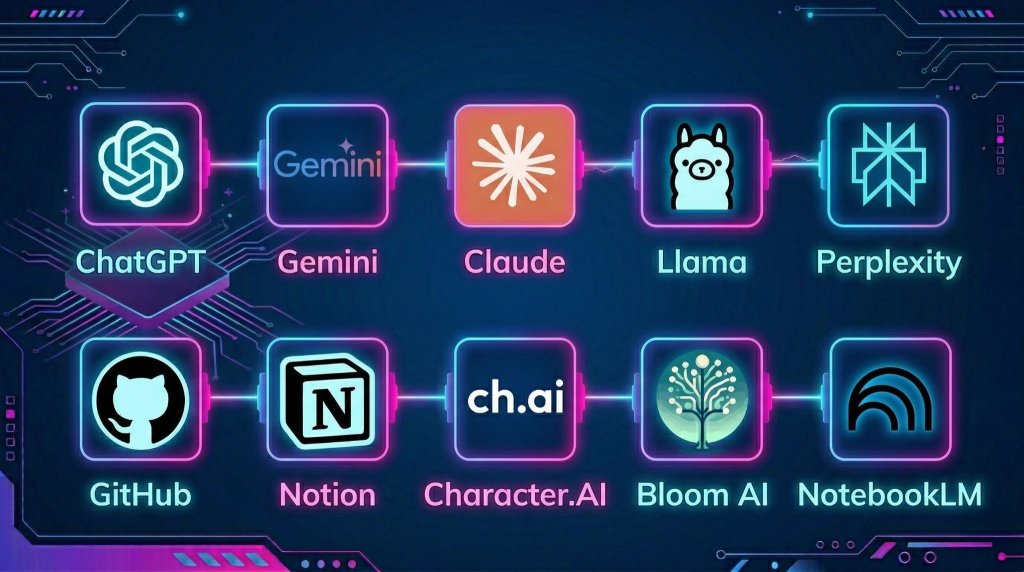
What Are the Most Popular Large Language Models (LLM)?
1. ChatGPT (GPT-4 / GPT-5)
ChatGPT remains the most popular and versatile model. It is balanced, fast and has a huge ecosystem of applications. It is accessible and easy to use, which makes it suitable for both beginners and professionals.
- Where to use it: Daily planning, idea generation, general assistance and tasks that require solid logical reasoning.
- Strength: It is extremely intuitive and good at “thinking” step by step.
2. Gemini (Google)
Gemini is the model developed by Google and is integrated into many of their products, such as Search, Gmail or Google Docs.
- Where to use it: Internet research (uses the Google search engine in real time), organizing emails and creating presentations.
- Strength: Seamless integration with Google services and the ability to analyze long video or audio files.
3. Claude
Claude (Opus 4.6 or Sonnet series) is the favorite of those who work a lot with text and complex data. It is considered the model with the most “human” tone and the least chance of providing dangerous or erroneous answers.
- Where to use it: Writing articles, analyzing very long legal or financial documents, and programming (coding).
- Strengths: The ability to process huge volumes of text simultaneously (large context window) and the elegant writing style.
4. Llama (Meta)
Llama is the model created by the parent company of Facebook and Instagram. The major difference is that it is “open”, meaning that other companies can download and run it on their own servers, without sending the data to Meta.
- Where to use it: In applications where data privacy is critical or in devices that need to work without the internet.
- Strengths: It is free for many developers and extremely flexible to be adapted to specific fields (e.g. medicine or law).
5. Perplexity AI
Unlike a regular chatbot, Perplexity is a hybrid between Google and an LLM. It searches the internet for information in real time and gives you a summarized answer, citing the sources for each statement.
- Where to use it: Quick research, fact-checking, and finding breaking news.
- Strength: Transparency (it shows you exactly where it got the information).
6. GitHub Copilot
This is a model that specializes exclusively in writing software code. It is integrated directly into programmers’ work tools and “guesses” the next lines of code they want to write.
- Where to use it: Application development, websites, and technical automation.
- Strength: Increases programmer productivity by up to 50%.
7. Jasper AI & Notion AI
These are not models created from scratch, but platforms that use the power of GPT or Claude, but are “trained” specifically for business needs.
- Jasper: It’s the ideal marketing assistant, generating ads, social media posts, and SEO-optimized blogs.
- Notion AI: Helps you organize your notes, summarize meetings, or turn a list of ideas into a project plan right in your workspace.
8. Character.ai
You can talk to a historical figure, a movie detective, or even a virtual “psychologist.”
- Where it’s used: Entertainment, role-playing, or practicing foreign language conversation.
- Strength: Simulated empathy and creativity in dialogue.
9. BLOOM
BLOOM is a global effort to create a giant model that doesn’t belong to a single corporation. It’s trained to understand dozens of languages and hundreds of programming languages.
- Where it’s used: In academia and in regions where American models don’t work as well.
- Strength: Cultural and linguistic diversity.
10. NotebookLM (Google)
This is a fascinating tool from Google that uses the power of Gemini models, but in a unique way. Instead of “talking” to the entire internet, it focuses only on the documents you give it (PDFs, lecture notes, transcripts).
- Where to use it: Students who want to understand difficult lectures, journalists who analyze voluminous dossiers, or researchers who want to make connections between dozens of studies.
- Strength: It can automatically generate an “Audio Overview” (like a podcast) in which two AI voices discuss your documents, explaining the main ideas in a way that everyone can understand.
LLM: Pros and Cons
Advantages of Using an LLM (Why Use Them)
- Huge Time Savings: You can summarize a 50-page report or write a draft email in just a few seconds.
- 24/7 Availability: Unlike a human assistant, an LLM is ready to help you at any time of the day or night, without getting tired.
- Creativity on Demand: Helps you overcome “writer’s block” by giving you ideas for headlines, article structures, or new marketing concepts.
- Multilingualism: You can translate complex texts or learn a foreign language by conversing with a model that perfectly understands grammar and context.
- Access to Vast Knowledge: You have access to information in extremely diverse fields, from history and cooking to software programming and physics.
Disadvantages and Limitations (What to Watch Out For)
- AI hallucinations: This is the biggest risk – sometimes the model can invent facts, historical data or sources with complete confidence. Always verify critical information!
- Lack of consciousness and emotions: An LLM does not truly “feel” or understand the world; it simply predicts the next word based on statistics.
- Data privacy: Any personal information or company secrets you enter into public models (like the free versions of ChatGPT) can be used to train future versions.
- Bias and prejudices: Because they are trained on human-written text from the internet, the models can pick up and propagate stereotypes or subjective opinions.
- Hidden costs: While there are free versions, the most powerful models and advanced features usually require a rather expensive monthly subscription.
The Future of LLMs
The future of LLMs is not just about longer texts or faster responses, but about such a deep integration into our lives that technology will become almost “invisible”. A major trend is personalization. LLMs will become increasingly tailored to each user, providing answers and recommendations based on needs, style and goals.
Here are the main directions in which these systems are evolving:
- Total multimodality: The future is no longer limited to writing. Models will become experts at “seeing”, “hearing” and “speaking” simultaneously. Imagine showing your phone a broken car part and it explaining to you in real time through voice how to fix it.
- Small and ultra-efficient models (SLM): We will move from huge models running on gigantic servers to small models that work directly on your phone or smartwatch, without the need for the internet. This means faster speeds and much better privacy for your data.
- Extreme personalization: The LLM of the future will get to know you. It will know your writing style, your coffee preferences, or how you prefer your agenda to be organized, becoming a personal assistant that anticipates your needs before you verbalize them.
- Autonomous AI agents: You will no longer have to chat with the model for each step. You will give it a complex task – for example: “Plan my summer vacation to Greece with a budget of 1500 euros” – and the AI will book the flights, hotel, and itinerary itself, communicating directly with travel websites.
- Impact in medicine and science: We expect LLMs to accelerate the discovery of new drugs and treatments by analyzing volumes of data that the human mind could not process in a lifetime.
As they evolve, LLMs will become increasingly integrated into our lives, and the ability to use them effectively will be an important advantage, regardless of the field we work in. Although technology comes with challenges, errors and the need to protect data, the secret to success in the new digital age is curiosity to learn and adaptability. The better we understand how to “drive” these digital co-pilots, the better prepared we will be for the future.
If you liked this guide, we invite you to explore the rest of our articles in the Artificial Intelligence category. Discover in-depth analyses, breaking news and practical tutorials that will help you stay up to date with everything that is happening in the AI universe.
And if you want to move from theory to practice and learn how to use AI in a real way, we invite you to discover our tech courses here.
Articol publicat de Laura Bojincă-Moisei
Specialist în Digital Marketing cu un background în Jurnalism și Psihologie, completate de certificări PPC și Social Media, Laura crede că cele mai bune campanii sunt cele care construiesc o conexiune umană autentică. Cu peste 10 ani de experiență în marketing și pasionată (până la „nerdiness”) de tehnologie, Laura rămâne un om al cuvintelor cu un apetit constant pentru a învăța lucruri noi.