What Is Vibe Coding?
If you’ve been following recent discussions in the tech world, you’ve probably heard the term “vibe coding.” It appeared suddenly on X, exploded on Reddit, and quickly became a topic of discussion among tech giants, corporations, and independent developers.
But what can we expect from vibe coding? Is it the end of traditional programming or just a new stage in the evolution of how we write code? In this article, we explore the two major directions of this phenomenon and why this trend generates real profits, not just online discussions.
So, What Is Vibe Coding?
Essentially, vibe coding refers to the practice of writing software using artificial intelligence (LLMs) through natural language commands, emphasizing creative flow (“vibe”) and the end result rather than code syntax. You no longer write for loops and manually define classes; you tell the AI what you want to achieve, and it generates the code.
Vibe coding can become a real business engine. The Lovable platform achieved $100 million in annual recurring revenue (ARR) in just 8 months after launch, becoming one of the fastest-growing software companies in history. Through vibe coding, the platform allows non-programmers to quickly launch complex applications; an inexperienced user built a functional business in just 10 days, generating $50,000 in revenue.
Why Is Vibe Coding More than Just a Trend?
In addition to its business potential, demonstrated by the rapid rise of startups that use it, such as Lovable, vibe coding will certainly establish itself as a paradigm because it solves several fundamental problems in the industry:
- Democratization of creation: The technical barrier has been broken down. Anyone with an idea and business logic can now build a product. You no longer need to know Python syntax, you need to know what you want to achieve.
- Speed from idea to market (time-to-market): Development cycles that used to take months are now reduced to days or hours. Companies can test hypotheses instantly, failing quickly and cheaply or scaling success immediately.
- Focus on logic, not syntax: Programming becomes an activity of system design and logic. The “vibe coder” (or agentic coder) is more of a technical product manager than a code typist.
However, the way we approach this process has divided the tech world into distinct camps.
1. Pure Vibe Coding: Andrej Karpathy’s Approach
The term was popularized in early 2025 by Andrej Karpathy (former AI director at Tesla and co-founder of OpenAI). In a viral post on X, he described a new mindset in programming:
“There’s a new type of coding that I call ‘vibe coding,’ where you let yourself be completely carried away by the ‘vibe,’ embrace the exponential, and forget that the code exists.”
In this approach, speed is everything – Karpathy mentions that he uses voice commands or short text and clicks “Accept All” on the AI’s suggestions without reading the differences (diffs). If an error occurs, the user simply copies it back into the AI and waits for it to be resolved. The code becomes a “black box.”
2. AI-Assisted Programming: Google’s Position
If vibe coding is about generating code quickly and hoping it works, the pair-programming workflow between agentic AI and a developer is currently recommended by specialists. This tandem of artificial intelligence and a programmer achieves both fast and accurate results, as it manages not only to write code, but also to test it, plan its architecture, and proactively fix errors.
Practical Example: An Application Built Through Google AI Studio
Want to test vibe coding on a small scale? You can use Google AI Studio with the Gemini model to experiment with the concept.
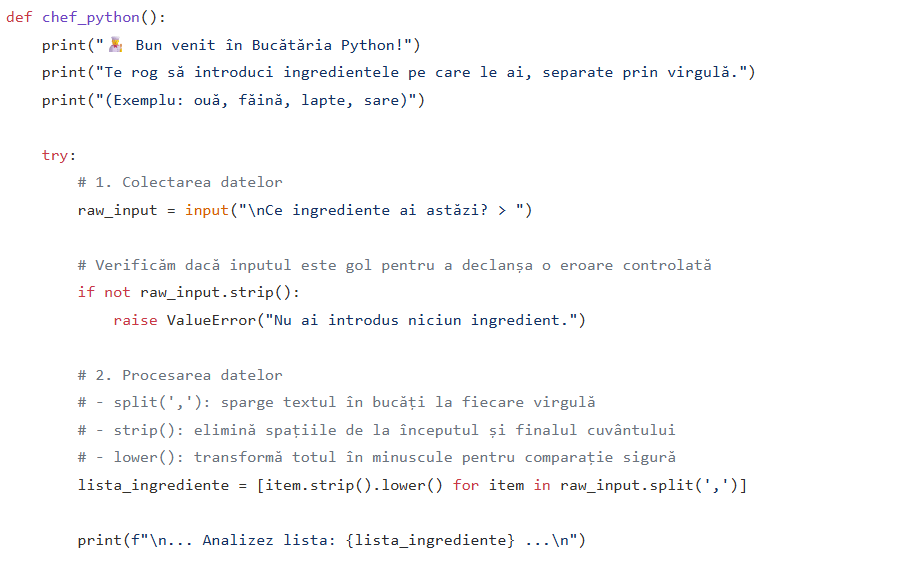
Here is a simple example of an application—a recipe generator based on the ingredients in your refrigerator.
Step 1: Go to aistudio.google.com and log in with your Google account.
Step 2: Define the prompt (System Instructions): In the left column, under “System Instructions,” set the context for the AI. Here we define the agent’s behavior:
“You are an expert culinary assistant and Python programmer. Don’t just write the code. First, explain the logical plan. Then generate a Python script that asks the user for a list of ingredients and returns a recipe suggestion. Include explanatory comments.”
Step 3: Interaction (Chat Prompt) In the chat window, write your request in natural language:
“I want a simple Python application. It should ask me what ingredients I have, and if I have ‘eggs’ and ‘flour’, it should suggest pancakes. If I have something else, it should suggest a generic omelet. I also want to see the ‘try-except’ logic for errors.”
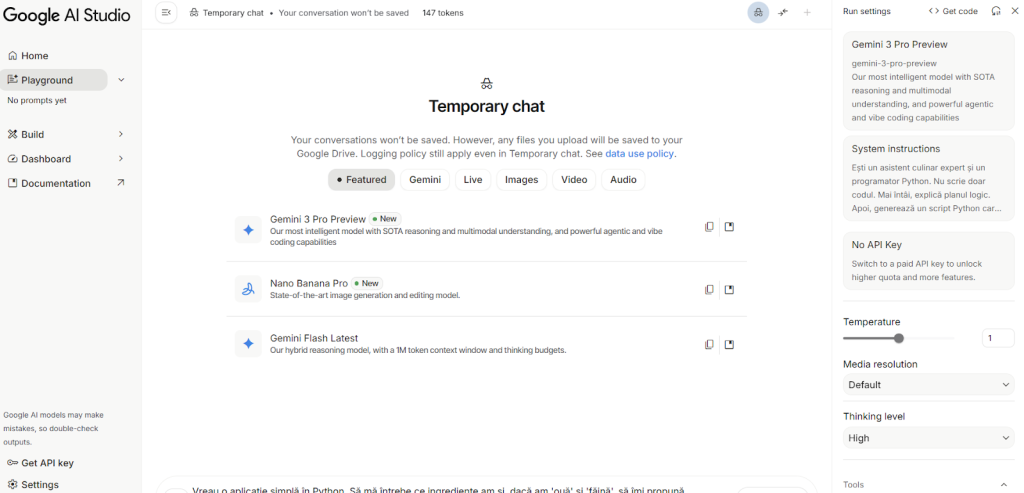
Gemini will act as a coding partner, explaining decisions and providing robust code that you can run immediately.
Our Conclusion
Whether you are a fan of Karpathy’s “pure” style or prefer the balanced approach promoted by Google, one thing is clear: the barrier to entry into the world of software creation has fallen dramatically. The key to success, however, remains the balance between the speed of AI and human discernment.
The tutorial below is a good example of vibe coding in action, demonstrating how you can go from a simple idea to a functional application using Google AI Studio and rapid iterations.
Articol publicat de Laura Bojincă-Moisei
Specialist în Digital Marketing cu un background în Jurnalism și Psihologie, completate de certificări PPC și Social Media, Laura crede că cele mai bune campanii sunt cele care construiesc o conexiune umană autentică. Cu peste 10 ani de experiență în marketing și pasionată (până la „nerdiness”) de tehnologie, Laura rămâne un om al cuvintelor cu un apetit constant pentru a învăța lucruri noi.