Evolving Workplaces: What Does the Future of Jobs Look Like in 2025-2030?
The classic interview question – Where do you see yourself in five years? – now demands more than a quick, semi-automatic answer. It requires understanding the profound forces reshaping the modern world.
Major macro trends—including rapid technological leaps (driven by AI), geopolitical shifts, demographic developments, economic instability, and climate change—are set to radically transform most jobs between 2025 and 2030. These forces fundamentally complicate the answer to this career planning staple.
How, then, can we determine how jobs will genuinely evolve and how professionals will be directly affected? In short: we turn to the experts. The definitive resource is the World Economic Forum’s (WEF) The Future of Jobs 2025 report, released in January 2025.
This landmark study provides crucial data on the job market’s near future, synthesizing insights from over 1,000 top global employers across 22 industry sectors and 55 economies worldwide. This report offers a fascinating, data-driven look into the world of the near future. Below, we present the main conclusions from the report, specifically tailored for the IT and Technology industry.
New jobs are emerging, old jobs are being forgotten. From IT to education, transportation, consulting, and many others, these transformations are impacting a wide range of professional fields. Currently, both the jobs available and the skills sought in the labor market, as well as employers’ recruitment strategies, are being reconfigured. Macrotrends act as powerful fuel poured on a fire that was already smoldering—they accelerate everything and guarantee that in five years, the world will look very different from previous years.
Because every change also means opportunity, we help you find out:
- Which jobs will be in greater demand or, conversely, will decline by 2030
- How the skills, knowledge, and abilities required at work will change
- What are the best upskilling and reskilling strategies for the next 5 years
- What type of interventions for hiring, motivating, and retaining staff will be on organizations’ agendas in the coming period…
- so that you can stay one step ahead and easily navigate even challenging and constantly changing professional contexts. Keywords: learning and adaptation.
The Wind of Change. Trends that Will Transform Our Jobs Over the Next 5 Years
Technological Leaps
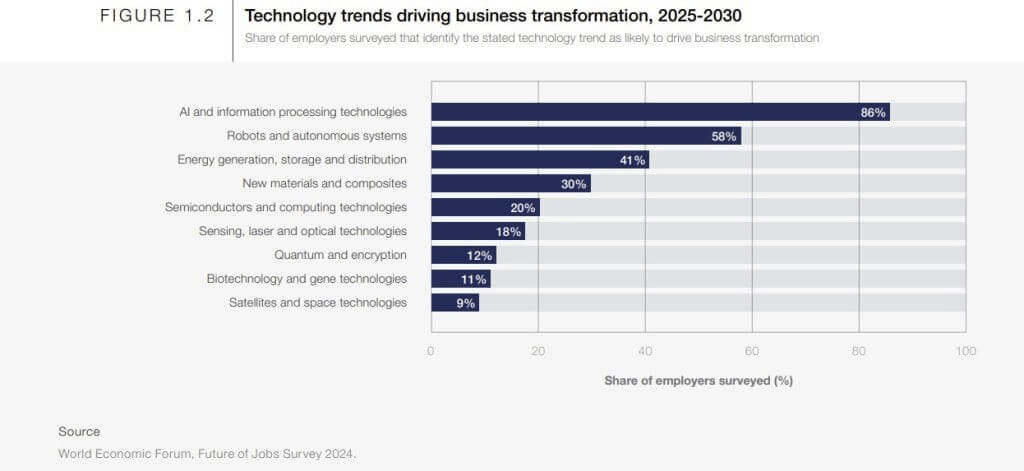
Technological change, particularly the expansion of access to digital tools for all, will significantly transform the business environment. While robots and autonomous systems, as well as energy generation and storage technologies, will have their impact, the biggest transformations by 2030 are expected to be driven by artificial intelligence (AI), particularly generative AI (GenAI). 86% of employers expect AI to change the work processes and systems in their organizations.
Since 2022, GenAI has seen a sharp increase in investment and user adoption. AI adoption is still relatively low overall, but it is growing rapidly (albeit unevenly, with the IT sector leading the way). GenAI has the potential to improve human skills and performance at work.
The WEF warns of the risk of AI replacing human labor if development does not focus on augmentation. However, these concerns are allayed by other studies, such as the Anthropic Economic Index, which analyzed millions of conversations with AI and concluded that:
- Currently, AI is most widely used in the fields of software development and technical writing. Around 36% of occupations use AI in at least a quarter of their tasks, and around 4% use it most of the time at work.
- The role of AI today leans more toward augmenting human abilities (57%)—working alongside humans and strengthening human skills—than toward pure automation (43%), where it directly replaces humans in completing tasks.
- Most often, AI is involved alongside the user in activities such as work verification (rereading and optimizing sequences performed by humans), learning (helping the user acquire new knowledge and skills), and task iteration (e.g., participating in brainstorming or performing repetitive tasks).
- AI is more commonly used in tasks within medium to high-paying occupations (programming, data analysis, etc.).
- The demand for GenAI skills training is growing—individual users are turning to basic knowledge acquisition, and organizations are turning to employee train
Demographic Changes
Two fundamental demographic changes are poised to profoundly impact global employment by 2030: the aging and decline of the working-age population in high-income economies, contrasted with the robust growth of the working-age population in low-income economies.
This shift will fundamentally alter the distribution of the global workforce, with low-income nations projected to account for the majority of the working-age population by 2050. Consequently, emerging economies face the critical challenge of ensuring job creation keeps pace with this expanding demographic.
Employer Strategies Against Shrinking Workforces
Faced with a shrinking talent pool in strong, high-income economies, employers are proactively adopting several key strategies:
- Internal Mobility: A significant majority (60%) of these companies are prioritizing the promotion and elevation of current employees into higher internal roles to fill skill gaps.
- Automation and Augmentation: Companies impacted by an aging population are more likely to accelerate process automation and push forward with workforce augmentation technologies to boost productivity and efficiency.
Economic Instability and Geopolitical Fragmentation
The global economic outlook for 2025 remains uncertain, although there are signs of a slight improvement compared to previous years. In 2024, inflation fell, but slow growth and political instability threaten many countries. The IMF forecasts economic growth of 3.2% in 2025, but with downward revisions for some countries, especially low-income ones. Inflation, particularly in services, remains a problem.
Companies see economic pressures such as the cost of living, geopolitical tensions, and international conflicts as major transformative factors. Geo-economic fragmentation threatens trade and supply chains. Trade restrictions have recently doubled in some regions, affecting global imports. This protectionism could stifle long-term growth because it reduces opportunities for innovation and technology transfer, two key factors that have ensured the progress of emerging economies during globalization.
The Transition to a Greener World
Almost half of the employers interviewed by the WEF anticipate that efforts to reduce carbon emissions and adapt to climate change will lead to significant organizational transformations. Certain industrial sectors such as the automotive, aerospace, and mining industries expect major changes in this regard, with employees needing to be retrained. There is concern about the availability of the skills needed for a net-zero economy (meaning zero greenhouse gas emissions). The demand for “green skills” exceeds the current supply, making their development essential.
How, Who, and Why. The Evolution of Jobs
Jobs
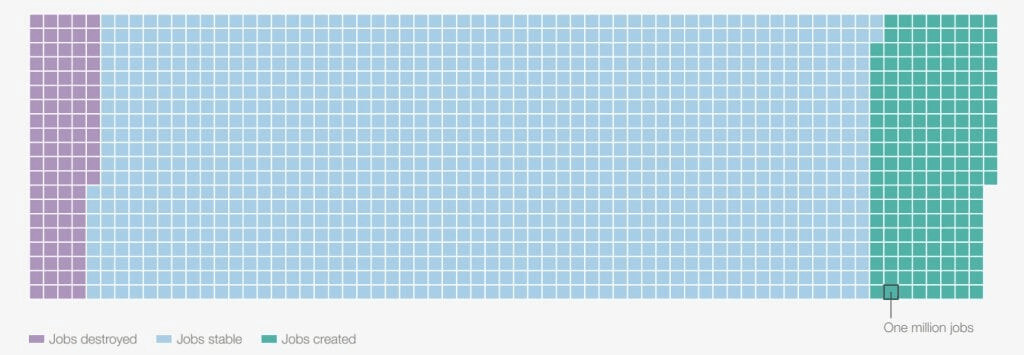
Over the next five years, it is estimated that 170 million new jobs will be created and another 92 million jobs will be lost, resulting in a net increase in employment of 7%, or 78 million jobs.
Jobs on the Rise or in Decline
The tech sector is seeing the fastest growth (in percentage terms) in jobs, with the following roles increasingly sought after worldwide:
- Big Data specialists
- Fintech engineers
- Artificial intelligence and machine learning specialists
- Software and application developers.
The growth in cybersecurity-related roles, for example Security Management Specialists (in the top 5 fastest-growing roles) and Information Security Analysts (in the top 15), is driven by both technological advances and increased geopolitical fragmentation.
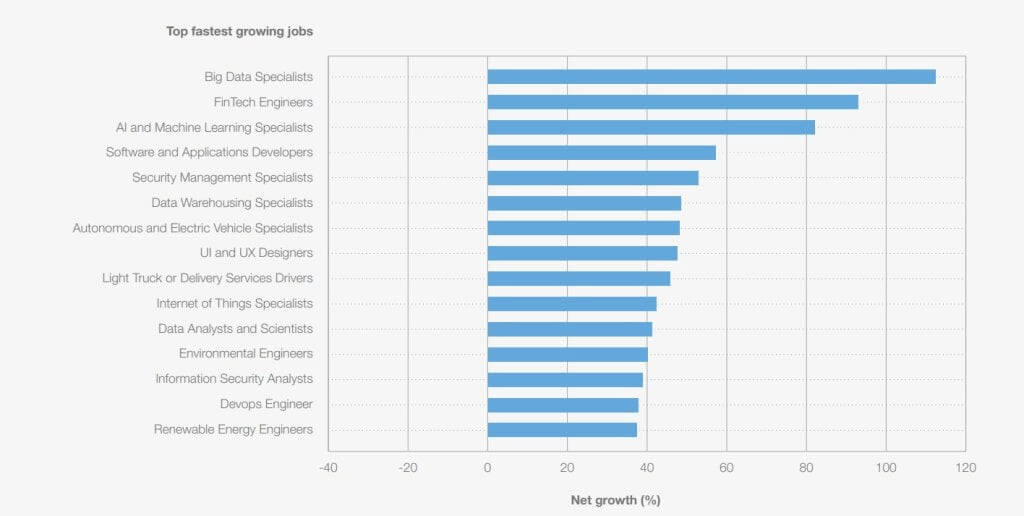
Roles in ecology and energy transition, including autonomous and electric vehicle specialists, environmental engineers, and renewable energy engineers, also feature in the WEF’s top fastest-growing roles.
Software and application developers, general and operations managers, and project managers are also among the categories with the highest job growth.
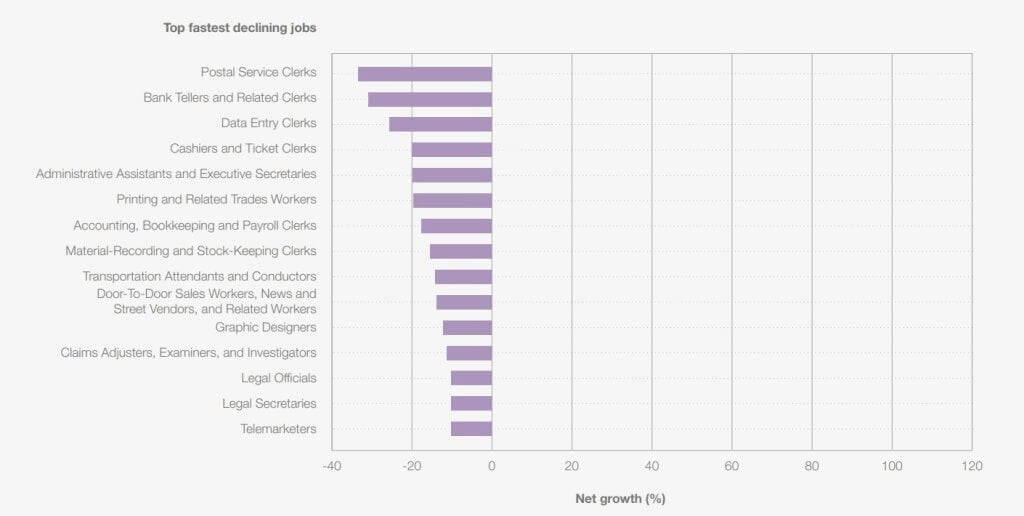
As for the roles that will decline in demand in the labor market over the next five years, they include cashiers, ticket sellers, administrative assistants, executive secretaries, typographers, and accountants/auditors. These declines are mainly driven by the trend toward digitization, the increased use of AI, and the automation of tasks such as self-checkout at stores. An aging population and slower economic growth are also contributing to the decline of some of these roles. The adoption of AI could also be key to slowing the decline in certain fields, especially creative ones.
Roles in education, such as university and pre-university teachers, are on the rise due to the expansion of digital access (which is changing the face of formal and informal education, with an emphasis on the online environment) and the shift towards continuing education at any age.
Skills, Knowledge, and Abilities
A changing world brings with it a basic concept: the transformation of the skills needed in the workplace (skills disruption).
Although employers initially anticipated that a significant transformation of employee skills would be necessary, they seem to have adapted to rapid technological changes, including the impact of the pandemic, and advances in areas such as AI. Globally, the expected change in skills is 39%, compared to 44% in 2023. This stabilization of skills is likely due to an increased focus on continuous learning and reskilling/upskilling, with an increasing percentage of employees participating in such programs. In Romania, employers expect 37% of employee skills to need to change by 2030.
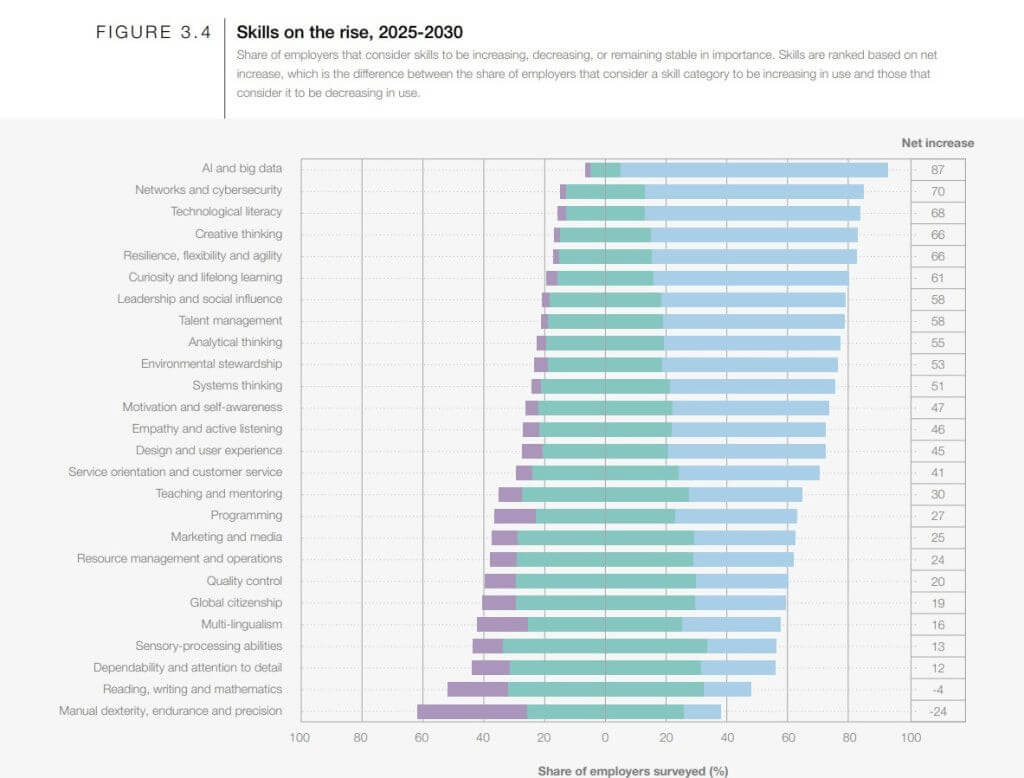
The top skills with the fastest growth in importance in the job market are:
- Use of AI
- Big Data and data analysis
- Network administration and cybersecurity
- Technological literacy.
In addition to these technology-related hard skills, soft skills such as creative thinking, resilience, and flexibility, as well as curiosity and lifelong learning, are expected to continue to grow in importance between 2025 and 2030.
Industries and Skills
Which are the top industries demanding increased employee skills, and in which areas?
AI and Big Data skills will be most in demand in:
- Automotive and aerospace technology
- Telecommunications
- Various professional services
- IT services
- Insurance and private pensions
- Finance and capital markets
- Supply and transportation
- Medicine and healthcare
- Energy and utilities
- Public administration and government.
Network administration and cybersecurity skills will be in high demand in the following industries:
- Finance and capital markets
- Insurance and private pensions
- Energy and utilities
- Medicine and healthcare
- Automotive and aerospace technology
- Government and public sector
- Supply and transport
- Telecommunications
- Advanced manufacturing
- IT services
Top areas for creative thinking skills:
- Insurance and private pensions
- Education and training
- Medicine and healthcare
- Advanced manufacturing
- Telecommunications
- IT
- Real estate
- Professional services
- Supply and transport
- Consumer goods manufacturing
Curiosity and continuous learning will be necessary in all fields, but especially in:
- Education and training
- Insurance and private pensions
- Telecommunications
- Real estate
- IT
- Automotive and aerospace technology
- Energy and utilities
- Retail
- Fossil fuels
- Medicine and healthcare.
Upskilling and Reskilling
According to employers, the skills gap is the biggest obstacle to business transformation. Most employers (85%) plan to prioritize upskilling within their company, while others plan to hire new talent from outside (70%), reduce staff (40%), or transfer/promote existing staff to new roles (50%).
The number of jobs worldwide is expected to grow by 2030, but the skills gap between growing and declining roles could exacerbate staffing shortages. Key skills that will differentiate sustainable jobs include:
Resilience
- Agility
- Resource management
- Quality control
- Programming
- General technological skills.
The evolution of skill requirements increases the need for workforce upskilling and reskilling. If the global workforce consisted of 100 people, 59 would need training by 2030. Of these, employers predict that 29 could be upskilled in their current roles and 19 could be upskilled and redeployed elsewhere within their organization.
Recruitment, Motivation, and Retention
Supporting employee health and well-being remains a key objective for organizations in order to retain current staff and build a good reputation that attracts new talent. Retraining, upskilling, and promoting talent are also considered key strategies. Employers consider funding and providing retraining courses to be the most useful organizational policies.
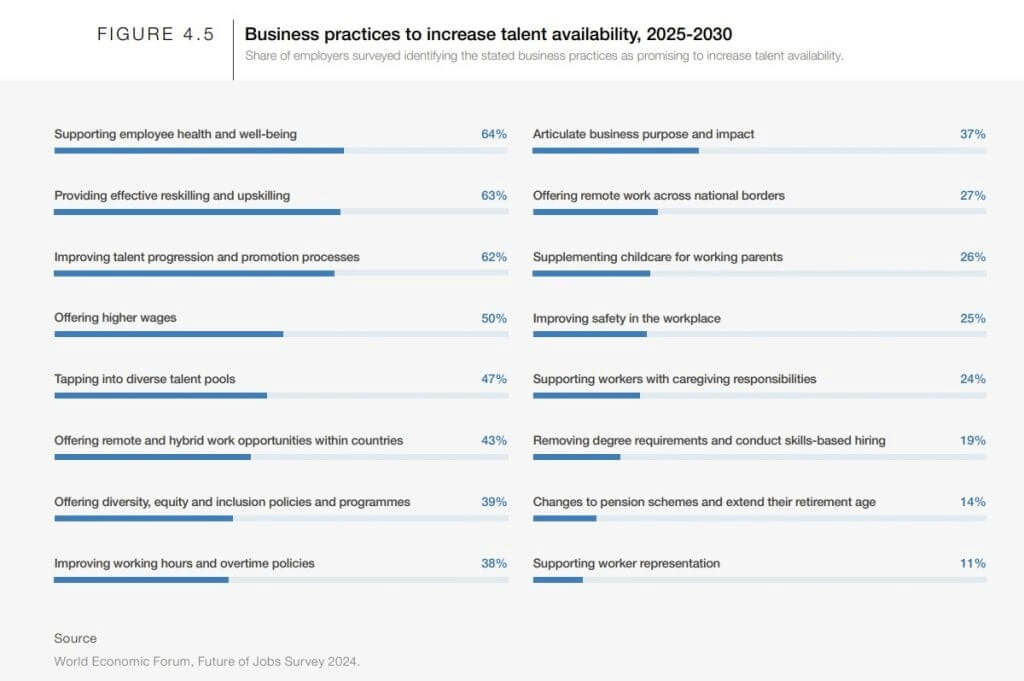
Initiatives focusing on Diversity, Equity, and Inclusion (DEI) are rapidly ascending the corporate agenda. Employers are demonstrating increased awareness regarding the strategic potential of leveraging diverse talent pools, with a significant 83% of large companies reporting they have active DEI programs in place. Looking toward 2030, a majority of companies anticipate allocating a larger share of their revenue to salaries, driven by sophisticated compensation strategies tied to productivity, performance metrics, and critical talent retention. Simultaneously, half of all employers are actively preparing for the profound impact of Artificial Intelligence (AI) on their operations, primarily through organizational restructuring or the strategic hiring of personnel possessing specialized AI and automation skills.
Sources:
Articol publicat de Laura Bojincă-Moisei
Specialist în Digital Marketing cu un background în Jurnalism și Psihologie, completate de certificări PPC și Social Media, Laura crede că cele mai bune campanii sunt cele care construiesc o conexiune umană autentică. Cu peste 10 ani de experiență în marketing și pasionată (până la „nerdiness”) de tehnologie, Laura rămâne un om al cuvintelor cu un apetit constant pentru a învăța lucruri noi.