IT Retraining in Romania: What Do The Numbers say? [Infographic]
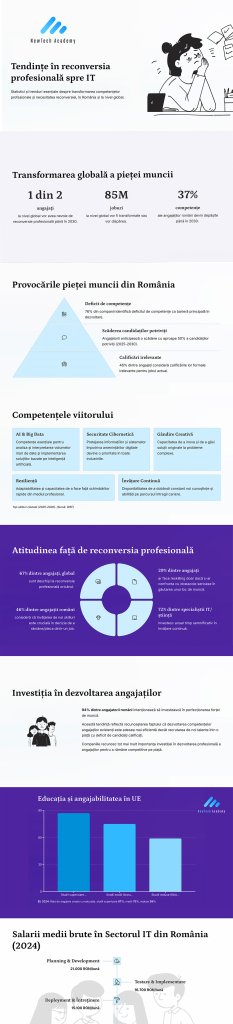
The current labor market is much more dynamic than it was a few decades ago. Professional reconversion in IT is a reality that more and more Romanians are experiencing or aspiring to. Market figures continue to show openness and opportunity for those who are thinking about this step and are preparing for it properly. To visualize these aspects concretely and better understand the reality of IT retraining, the infographic at the end of our article presents a summary of key data.
Indeed, the Romanian IT market has slightly slowed down the rapid growth rate of previous years, becoming more selective and mature. However, recent statistical data and forecasts from global and local experts suggest that opportunities persist, and retraining and constant adaptation of skills are becoming not just an option, but a strategic necessity for anyone who wants to remain relevant in the labor market.
Radical Transformation of Skills
The labor market is rapidly transforming through digitalization, automation, and AI. The WEF “Future of Jobs” 2025 report shows that by 2030, 37% of Romanians’ skills will become obsolete. The need for skills in AI, cybersecurity, and technology, as well as creative thinking and continuous learning, is growing exponentially. Romanian employers anticipate a decrease of almost 50% in the number of suitable candidates available in the coming years, so they plan to both hire and train new staff. Globally, it is estimated that about half of employees will need to be retrained by 2030, as 85 million jobs will transform. There is a systemic need to adapt through retraining and upskilling.
HR Paradigm Shift: From Diploma Focus to Competency Search
In response to the talent shortage, employers are moving from diploma-based selection to one based on demonstrated competencies, according to the PwC report “Putting Skills First”. Statistics show that 46% of employees consider their formal qualifications irrelevant for the job they currently hold. Focusing on practical skills and learning potential can greatly broaden the talent pool. 76% of Romanian companies consider the current skills shortage as a problem for their development. Strategically, 94% of employers (above the global average) invest in workforce development, and 79% will hire staff with new skills. This focus on “skills first” will favor, over time, professional retraining, removing an important barrier in its path – the need for an academic degree in the new field.
IT Retraining in Numbers
All these trends – from the accelerated transformation of skills, to the paradigm shift in HR, and to the confirmed potential of the Romanian IT market – are key factors that justify a strategic professional retraining in this field. The strongest arguments lead towards investing in developing digital skills and exploring IT opportunities, as you can see in the infographic below.
Sources:
https://reports.weforum.org/docs/WEF_Future_of_Jobs_Report_2025.pdf
https://www3.weforum.org/docs/WEF_Putting_Skills_First_2024.pdf
https://www.pwc.ro/en/publications/Raport-Workforce-Hopes-and-Fears-Romania-2024.pdf
https://adevarul.ro/economie/reconversia-profesionala-provocare-pentru-2340888.html
https://www.anofm.ro/wp-content/uploads/2025/04/Raport-formare-martie-2025.pdf
Articol publicat de Laura Bojincă-Moisei
Specialist în Digital Marketing cu un background în Jurnalism și Psihologie, completate de certificări PPC și Social Media, Laura crede că cele mai bune campanii sunt cele care construiesc o conexiune umană autentică. Cu peste 10 ani de experiență în marketing și pasionată (până la „nerdiness”) de tehnologie, Laura rămâne un om al cuvintelor cu un apetit constant pentru a învăța lucruri noi.